
Sex Offender Checks in Washington County
The Texas Public Sex Offender Registry, managed by the Texas Department of Public Safety Crime Records Division, is the first official channel for a Washington County search. It can answer a name-based question and a geographic one. A county, city, ZIP code, or address search may reveal different useful views. Search controls can change, so follow the labels on the live interface and do not assume an older screenshot shows every current option.
The Washington County Sheriff's Office is the local registration authority for people who reside in its jurisdiction. Its verified general number is 979-277-6251. The official sources reviewed did not publish registration-counter hours or a verification appointment schedule. Call before going to 1206 Old Independence Road in Brenham. Ask the sheriff about local registration procedure or suspected noncompliance, but use 911 for an emergency. Do not confront a person shown in a registry result.
Washington County DPS Registry Route
The DPS search screen puts the public statewide database in one place. The official Texas registry search is the source for the captured interface below. It is free and does not use the paid credits required by the separate DPS criminal-history name product.
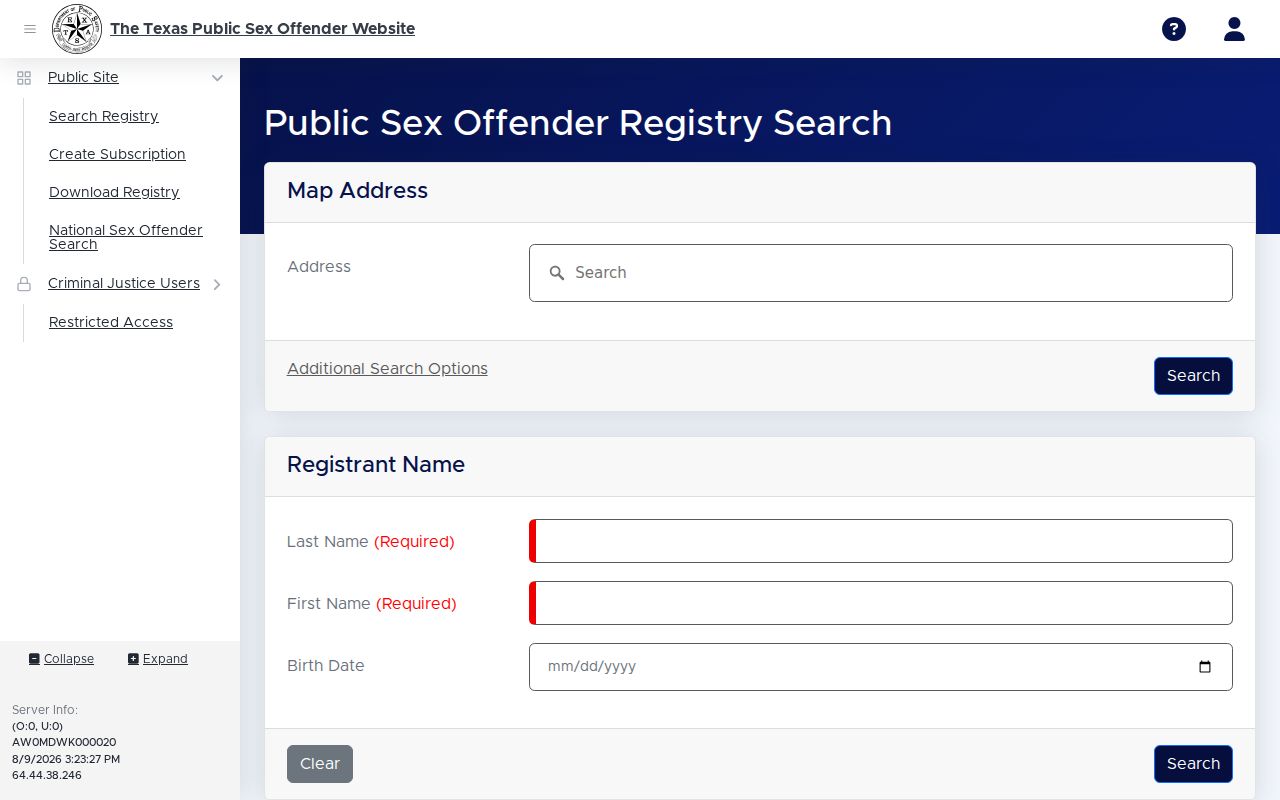
The screen matters because it shows that a registry check can begin with either identity or geography. A result still needs careful review. A shared name does not establish identity, and a map point should be read with the profile's status and reporting data.
How to Search the Texas Public Sex Offender Registry
Choose the path that fits the question. Use a name when a specific identity is known. Use county, city, ZIP, or address criteria for community awareness. DPS is the controlling source for Texas public data, while the sheriff can answer local registration questions that the public display does not settle.
- Open the DPS registry and read its conditions of use before entering search terms.
- Enter a last name with other identifiers, or select Washington County and add Brenham, Burton, a ZIP code, or an address when the live screen allows it.
- Compare the result list with lawful public identifiers. Do not decide identity from a name or image alone.
- Open the full profile and read status, offense, dates, duration, and reporting authority before drawing a conclusion.
| Field label | Type | Required | Use |
|---|---|---|---|
| Last Name | Text | Name path | Check live rules for partial or exact matching |
| First Name | Text | Optional narrowing | Helps separate people with the same surname |
| County | Dropdown | Geography path | Select Washington |
| City | Text or dropdown | Optional | Use Brenham or Burton when the control is shown |
| ZIP Code | Text | Geography path | Radius choices may appear on the live screen |
| Address | Text | Map or address path | Use for a lawful safety purpose |
| Institute of Higher Education | Search option | Optional | Use only when exposed by DPS |
| Search / Clear | Buttons | Interface | No paid search credit is required |
Washington County Registry Call-Ahead Facts
A public profile cannot answer every local process question. Washington County residents should call the sheriff for registration-office hours, verification appointments, or a report of possible noncompliance. The county department directory is the fallback for confirming the current agency route. The research found no published local schedule, separate county map, or email-alert product. Those gaps should not be filled with a neighboring county's rules.
When reporting a concern, give clear facts such as the location, date, observed conduct, and the profile involved. Let law enforcement assess compliance. Registration duties can cover a change in name, address, work or school information, vehicles, online identifiers, or travel when Texas law requires the update. The exact duty and check-in rate depend on the statutory category, so a missed public field is not proof of a violation. Recheck the official county homepage if a local contact changes.
Inside a Registry Profile
A DPS public profile joins identifying facts with registration and offense data. Read the record as a set. A photo can age, an alias can resemble another person's name, and an address can change. Status, verification date, reporting agency, and registration end information add context that a result-list view may not show.
| Name and aliases | Registration name plus other public names used to help identify the record |
|---|---|
| Photo and physical description | Image and public descriptors such as sex, race, height, weight, hair, eyes, age, or marks |
| Address and affiliations | Public county, city, ZIP, address, and any work, school, or vehicle details released by law |
| Offense information | Description, statute, conviction or adjudication date, and limited victim age or sex category where public |
| Risk information | Assigned risk level if DPS displays it; this is not the registration-duration category |
| Registration status | Status, verification date, reporting agency, start or end information, or a lifetime duty |
Victim identity does not belong in a public profile. Article 62.005 protects victim-identifying information even while authorizing release of specified registry data. Never use offense details to guess, publish, or spread clues about a victim.
Washington County Registration Program Context
DPS publishes the statewide legal framework through its Texas Sex Offender Registration Program page. That official program source explains why local verification is part of a statewide duty rather than a stand-alone Washington County list.
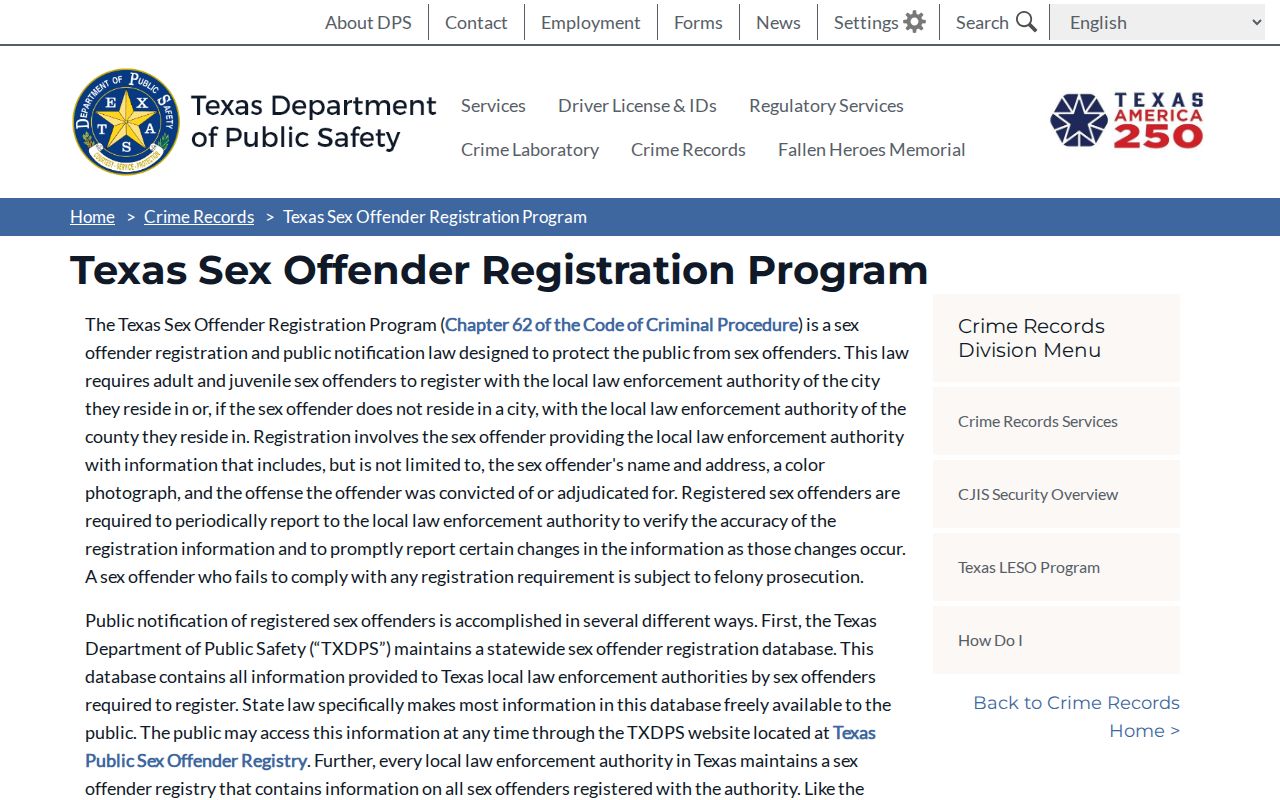
The program view helps separate three ideas: the legal duty to register, the public data DPS may release, and the sheriff's work as local registration authority. Those layers can update on different schedules, which is why an apparent error should be checked with the reporting authority rather than treated as fact.
Texas Registration Levels and Requirements
Texas does not use a simple public three-tier duration chart. Duration is offense-driven under Code of Criminal Procedure article 62.101. Enumerated offenses and conditions can produce a lifetime duty. Other adult reportable convictions generally run until the tenth anniversary after release from a penal institution or discharge from community supervision, whichever occurs later. Juvenile rules and early-termination paths differ.
| Texas concept | Duration or effect | Verification point |
|---|---|---|
| Lifetime category | Life for enumerated offenses or conditions under article 62.101 | Frequency depends on the statutory category |
| Ten-year adult category | Generally ten years after the later of release or supervision discharge | Frequency depends on the statutory category |
| Juvenile registration | Separate rules may allow exemption, unpublishing, or termination | Apply the juvenile provisions, not the adult shortcut |
| Risk level | An assessment and community-notification concept, not duration | Do not convert it into a tier deadline |
Do not infer a deadline from the word "level." The profile and governing offense category control. The sheriff's unpublished local appointment details also should not be guessed from the duration table.
Washington County NSOPW Cross-Check
The National Sex Offender Public Website adds a cross-state search across participating state, territorial, and tribal systems. It is useful when a person may have lived outside Texas or when a place-based check sits near a jurisdiction boundary.
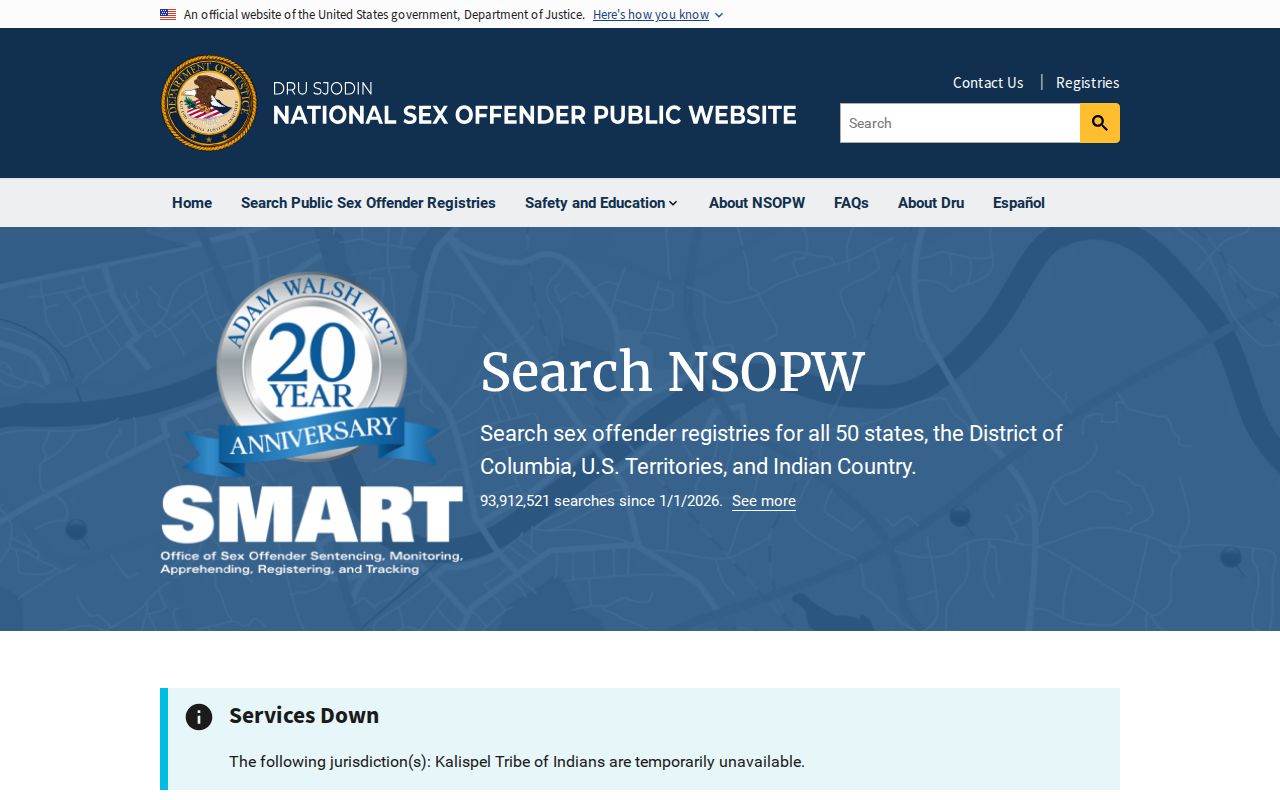
NSOPW is a supplement, not a replacement for the Texas DPS record. Participation and data flow depend on the contributing jurisdiction. Return to the DPS profile for Texas details and contact the Washington County sheriff when the question concerns current local registration.
When Washington County Registry Data Lags
An address, status, or image that seems old should be verified, not corrected by public contact. Record the profile link and the field at issue. Check the DPS registry again, then call the reporting authority shown on the profile or the Washington County sheriff. Explain the possible mismatch without making a public accusation.
A missing person is not proof that no duty exists. It may reflect spelling, search criteria, another reporting jurisdiction, a lawful change in publication status, or a record outside Texas. A displayed person is not proof of a new offense. Registry status and court history answer different questions, and the national layer has its own participation limits.
Check the dates before deciding that two sources conflict. A verification date tells when a required check occurred, while an offense date, conviction date, registration start, and projected end date describe different events. The reporting agency field can also point to a jurisdiction outside Washington County. If the record belongs to another Texas authority, that office may be better placed to explain its current entry. Keep a copy of the official URL and note when it was viewed. Avoid reposting an old screenshot as though it were a live status report.
Community Notification and Lawful Use
Public registry information supports personal, family, and neighborhood safety. Use it to understand an area, confirm official status, and share a direct government link when awareness is needed. Do not trespass, contact a registrant, crowd a residence, or treat the profile as authority to punish anyone. Send suspected noncompliance to law enforcement and keep victim information private.
Registry misuse warning: Texas Code of Criminal Procedure article 62.005 permits release of specified registry data but does not authorize threats, harassment, vigilantism, or another offense. Misuse can bring criminal or civil consequences.
The safest community notice repeats only what the official source states. It does not add rumors or infer facts from an address. For an immediate threat, call 911. For a routine compliance concern in Washington County, use the sheriff's verified general line.
Safety planning can stay practical and neutral. Confirm an address through the live government profile, discuss age-appropriate boundaries with family members, and report conduct rather than spreading claims about a person. The registry lists qualifying legal records; it does not predict future conduct or transfer law-enforcement power to the public. Washington County residents should let DPS and the sheriff maintain the official data trail.